20-foot double-ender with a 7-foot beam and 28" draft.
The stem is laminated mahogany, the frames are fir. The keel, stern-post, knees, battens, chine, sheer, engine & boiler stringers are all made of oak. (Well, the keel was originally oak...see the link to the ACCIDENT on the main page for an update). The hull is planked with 3/8" marine plywood, covered with fiberglass.
BOILER
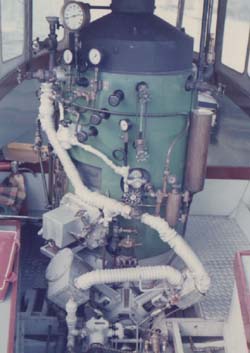
The vertical fire tube boiler was built for this boat by King Brothers in Portland, Oregon.
It is 44" high and is 24" in diameter. It houses 85 tubes. They are 1.25" in diameter, exposing 54 sq. ft. of heating surface. The boiler now operates at 140 lbs of pressure, down from the 180 at which it operated when new. This in spite of being rated at 200 lbs
constant pressure and regularly passing an annual hydrostatic test at 250 lbs. The boiler is fueled by steam-atomized oil and originally used a modified paint spray gun as an atomizing nozzle. That system has now been updated - eliminating the paint gun and replacing it with a commercial oil burner nozzle. (The "oil" has historically been diesel, but in recent years, we have made friends with the local oil-change garage and after triple filtering, the resulting product is mixed 50-50 with diesel from the pump for an economical fuel source). Atomization is provided by propane until 15 pounds of steam is raised. Steam pressure closes a check valve in the propane line, automatically converting atomization to steam. With the boiler filled to 2/3 capacity, it takes about 30 minutes to raise steam. The fire "drinks" about 3 gallons of fuel per hour. The propane is stored in two small tanks located in a ventilated area at the stern.
ENGINE
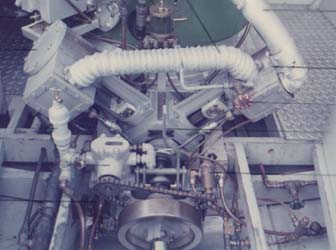
The engine is a Semple 10 horsepower V-Compound 3-5-4.
Lubrication is accomplished internally by means of a hydrostatic lubricator, and externally through an open drip feed crosshead lubricator. A conveniently placed oil can provides lubrication for both the valve linkage and the eccentric. The red valve adjacent to the high pressure cylinder (on the right) is a simpling valve, used to "jump start" the engine when the low pressure cylinder can use a little extra steam. The chain drives both the feedwater pump and the vacuum pump.


 It is 44" high and is 24" in diameter. It houses 85 tubes. They are 1.25" in diameter, exposing 54 sq. ft. of heating surface. The boiler now operates at 140 lbs of pressure, down from the 180 at which it operated when new. This in spite of being rated at 200 lbs
constant pressure and regularly passing an annual hydrostatic test at 250 lbs. The boiler is fueled by steam-atomized oil and originally used a modified paint spray gun as an atomizing nozzle. That system has now been updated - eliminating the paint gun and replacing it with a commercial oil burner nozzle. (The "oil" has historically been diesel, but in recent years, we have made friends with the local oil-change garage and after triple filtering, the resulting product is mixed 50-50 with diesel from the pump for an economical fuel source). Atomization is provided by propane until 15 pounds of steam is raised. Steam pressure closes a check valve in the propane line, automatically converting atomization to steam. With the boiler filled to 2/3 capacity, it takes about 30 minutes to raise steam. The fire "drinks" about 3 gallons of fuel per hour. The propane is stored in two small tanks located in a ventilated area at the stern.
It is 44" high and is 24" in diameter. It houses 85 tubes. They are 1.25" in diameter, exposing 54 sq. ft. of heating surface. The boiler now operates at 140 lbs of pressure, down from the 180 at which it operated when new. This in spite of being rated at 200 lbs
constant pressure and regularly passing an annual hydrostatic test at 250 lbs. The boiler is fueled by steam-atomized oil and originally used a modified paint spray gun as an atomizing nozzle. That system has now been updated - eliminating the paint gun and replacing it with a commercial oil burner nozzle. (The "oil" has historically been diesel, but in recent years, we have made friends with the local oil-change garage and after triple filtering, the resulting product is mixed 50-50 with diesel from the pump for an economical fuel source). Atomization is provided by propane until 15 pounds of steam is raised. Steam pressure closes a check valve in the propane line, automatically converting atomization to steam. With the boiler filled to 2/3 capacity, it takes about 30 minutes to raise steam. The fire "drinks" about 3 gallons of fuel per hour. The propane is stored in two small tanks located in a ventilated area at the stern.
 Lubrication is accomplished internally by means of a hydrostatic lubricator, and externally through an open drip feed crosshead lubricator. A conveniently placed oil can provides lubrication for both the valve linkage and the eccentric. The red valve adjacent to the high pressure cylinder (on the right) is a simpling valve, used to "jump start" the engine when the low pressure cylinder can use a little extra steam. The chain drives both the feedwater pump and the vacuum pump.
